Automotive
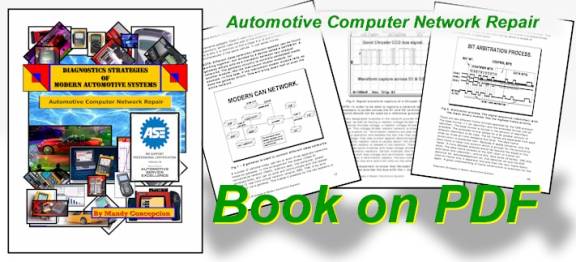
Computer Network Repair book on PDF
Learn the deep science of
automotive computer networks with this straight-to-the-point book on pdf.
Covering all automotive network communication network protocol, this book deals
with theory and practical auto diagnostics. Ever had a car with a non-shifting
transmission or a dashboard that won’t function due to the network? Yes, it is
true. If the network is down, on almost all car today, the car won’t work or
even start. With as many as 16 on-board computer networks, today’s vehicles are
very complex. Learn how this technology works.
(Click link
bellow for secure purchase. After purchase your download link will be sent to
you… Enjoy.)
About this Book on PDF
In this book on PDF,
Automotive Computer Network Repair, we will cover the intricacies of automotive
inter-module communication systems or networks. The scope of this section will
also go beyond the normal needs of an automotive technician. Hence, this will
probably be the most difficult part of this automotive discourse to comprehend.
Be patient and open minded. Always give yourself time to absorb the knowledge
and do not be discouraged. Special emphasis will be placed on the CAN system
(Controller Area Network), since it is bound to become the standard.
Automotive
Computer Network Repair
Table
of Contents
1.
INTRODUCTION
* -
Automotive inter-module communication systems or networks
* -
Asian, Domestics and European Vehicles
* -
Fully Networked vehicles.
2. THE
NEED FOR IN-VEHICLE NETWORKING
* -
Use of electrical and electronic components
* -
Networked automotive sensors.
* -
Sharing of sensor information
* -
Weight savings and the simpler wiring harnesses
* -
Networking and modular systems
3. THE
NEED FOR PROTOCOLS
* -
CAN or Controller Area Network communication protocol
* -
CLASS A – Low speed
* -
CLASS B – Medium speed
* -
CLASS C – High speed
* -
SAE (Society of Automotive Engineers)
* -
ISO (International Standards Organization)
* -
What is a Gateway?
4.
NETWORKING ESSENTIALS
* -
the 7-layer ISO/OSI reference model
* -
PHYSICAL LAYER
* -
DATA LINK LAYER
* -
APPLICATION LAYER
* -
The Node Oriented and Message Oriented (Producer-Consumer) protocols
* -
Medium Access
* -
CARRIER SENSE MULTIPLE ACCESS or CSMA
* -
Network latency
* -
The Topology of a network
* -
The STAR topology
* -
The BUS topology
* -
The TREE topology
* -
The RING topology
5.
DIFFERENT COMMUNICATION NETWORK
* -
The CCD data bus (Chrysler Collision Detection)
* -
CCD bus ground
* -
CCD bus bias voltage
* - OEM
scan tool (DRB III)
* - NO
TERMINATION message fault
* -
The PCI bus (Programmable Communications Interface)
* - A
CSMA/CD media access scheme
* -
The Header, DATA, CRC, IFR and EOF elements
* -
DCL (Data Communications Link)
* -
circuit 914 and 915
* - SCP
(J1850) (Standard Corporate Protocol)
* -
Dual wire twisted pair bus topology
* -
The ISO 9141 protocol
* -
The NGS “DATA LINK DIAGNOSTICS” menu option
* - GM
(Data Line) UART Serial Communications
* -
UART data line communications
* - GM
CLASS 2 data bus
* -
State of health messages
* -
The Tech-2 scanner has a dynamic menu configuration
* -
The Tech-2’s PING-ALL-MODULES
6. CAN
(Controller Area Network)
* -
implementation of the CAN protocol
* - 11
bit and 29 bit identifyer
* -
EPA approved for MY 2003 and up
* -
CAN A, B and C
* -
MID and PID CAN identifyers
* -
Master time-keeper-node
* -
Drive-by-wire systems
* -
Byteflight, Flexray, and Time-triggered CAN or TTCAN
* -
The CAN Data-Frame
* -
Recessive (high) or dominant (low) CAN communication.
* -
The CAN bus-access arbitration
* -
SOF (start-of-frame) bit
* -
Control bit
* -
Arbitration bits
* -
Data bits
* -
EOF or end of frame bit
copyright
Mandy Concepcion, Automotive Diagnostics & Publishing